GenPeima's HRD assessment combines BRCA1/2 pathogenic variant detection with a genomic instability score, helping the treating oncologist see how well a tumor can repair its own DNA — and which therapies are more likely to work against it.
Illustrative representation of a genomic instability read-out — not an actual patient result.
Homologous Recombination Repair (HRR) is an essential, evolutionarily conserved mechanism that repairs double-strand breaks (DSBs) in DNA — damage caused by everyday factors such as ultraviolet light, reactive oxygen species, and errors during DNA replication. Unlike faster, error-prone repair routes, HRR uses an intact copy of the damaged sequence as a template, allowing the break to be repaired with near-perfect accuracy. HRR operates through two complementary mechanisms: repairing double-strand breaks directly, and protecting stalled replication forks from degradation.
When a double-strand break occurs, a coordinated sequence of proteins repairs it using the matching sequence on the sister chromatid as a template:
HRR also safeguards the replication process itself, protecting stalled replication forks until they can safely resume:
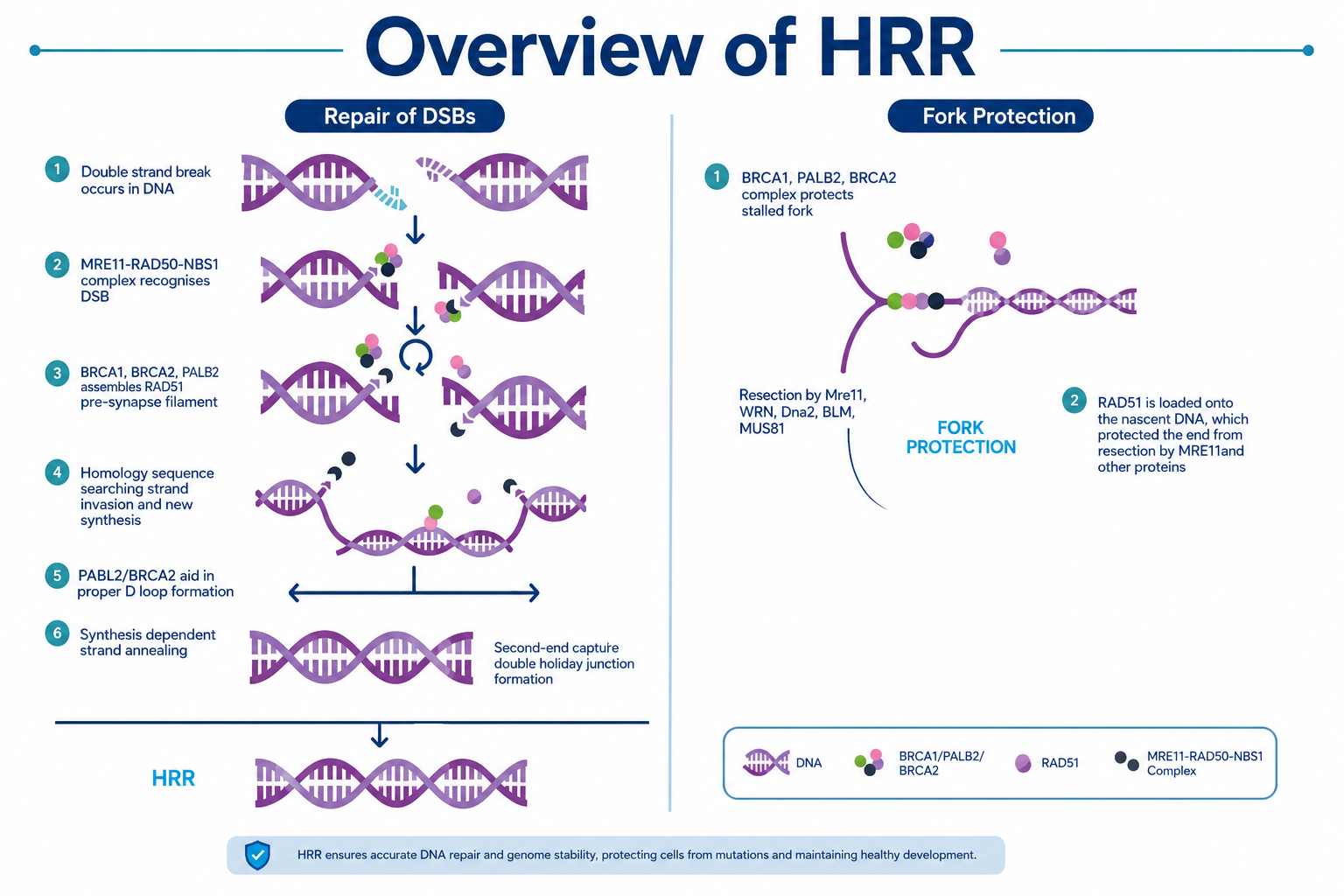
Figure 1. HRR repairs double-strand breaks and protects stalled replication forks through two coordinated mechanisms.
DNA in every cell is damaged and repaired continuously, every day. Healthy cells rely on highly accurate systems — including HRR — to manage this constant turnover. When HRR is impaired, as it is in a substantial proportion of ovarian and other cancers, cells lose the ability to repair double-strand breaks accurately. This loss of repair capacity, together with the genomic instability it leaves behind, is what defines Homologous Recombination Deficiency (HRD).
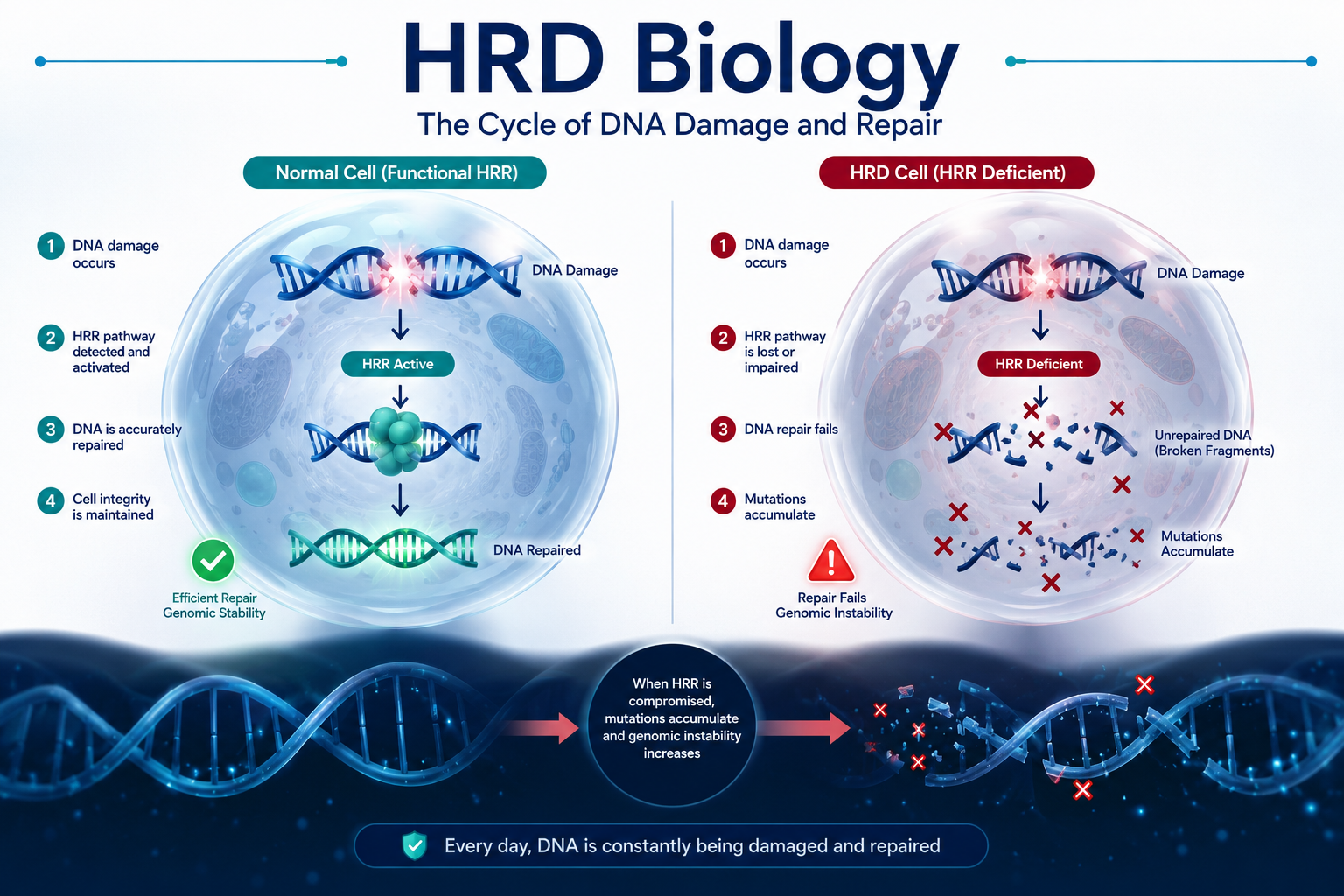
Healthy cells repair DNA damage continuously through HRR. When this mechanism is impaired, damage accumulates — producing the HRD phenotype.
Single-strand DNA breaks happen routinely and are normally resolved through base excision repair, a process that involves PARP enzymes. PARP inhibitors block this route, causing single-strand breaks to persist and convert into double-strand breaks during DNA replication. In HR-proficient cells, these breaks are still repaired accurately through homologous recombination, and the cell survives. In HR-deficient cells, no functional back-up repair pathway is available: the double-strand breaks go unrepaired, and the cell dies. This selective vulnerability — often described as synthetic lethality — is the biological rationale for using PARP inhibitors in HRD-positive tumors.
PARP inhibition converts single-strand breaks into double-strand breaks. HR-proficient cells repair the damage and survive; HR-deficient cells cannot — the basis of PARP-inhibitor efficacy in HRD-positive tumors.
Several genes coordinate the HRR pathway; when any one of them is inactivated, the risk of HRD rises. Genes most frequently implicated include:
These genes are frequently mutated or epigenetically silenced in high-grade serous ovarian cancer (HGSOC), among other tumor types.
Every day, ordinary cellular stress — replication errors, reactive oxygen species, UV exposure — breaks both strands of the DNA helix. Understanding how cells normally fix this damage is the starting point for understanding HRD.
Healthy cells repair double-strand breaks with near-perfect accuracy through Homologous Recombination Repair (HRR), a pathway coordinated by genes including BRCA1, BRCA2, PALB2, ATM, ATR, BRIP1, CHEK1/2 and NBN.
When one of these genes is disabled — by mutation or epigenetic silencing — the cell falls back on error-prone backup routes such as non-homologous end joining. Breaks are patched imperfectly, and the genome accumulates structural scars over time. That combination of a broken repair pathway and the damage it leaves behind is what defines Homologous Recombination Deficiency (HRD).
A single BRCA1/2 sequencing result can miss a large share of HRD-positive tumors. GenPeima's assessment looks for both the cause and the consequence of repair failure.
Targeted sequencing of BRCA1 and BRCA2 identifies deleterious mutations that directly disable the HRR pathway — both germline and tumor-acquired.
A composite score built from three structural "scar" markers left behind by defective repair, regardless of which gene caused it.
Because genomic scars persist even when the original mutation can no longer be found, the instability score can identify HRD in tumors that test BRCA wild-type — a group that gene-panel testing alone would otherwise miss.
HRR-deficient tumors struggle to repair DNA damage on their own, which tends to make them more sensitive to therapies that inflict further damage — platinum-based chemotherapy and PARP inhibitors. Regulatory agencies including the FDA and EMA have authorized PARP-inhibitor use in ovarian cancer guided by HRD status, giving oncologists an additional, biology-based factor in treatment selection.
Especially high-grade serous histology, at diagnosis and at recurrence.
BRCA-associated and sporadic triple-negative disease.
A subset of ductal adenocarcinomas carry an HRD signature.
Metastatic and castration-resistant presentations.
The treating institution submits an FFPE tumor tissue block or slides, following GenPeima's sample requirements.
BRCA1/2 sequencing and genomic instability scoring are performed on the same tumor specimen.
An HRD status report is delivered to the treating oncologist to support therapy selection. Contact our team for current turnaround times.
An HRD-positive result indicates the tumor has a reduced ability to repair DNA damage through homologous recombination. This information can help the treating oncologist weigh the potential benefit of PARP inhibitors or platinum-based chemotherapy alongside other clinical factors — it is one input among several in the treatment decision, not a standalone prescription.
No. While ovarian cancer — particularly high-grade serous histology — has the most established link to HRD-guided therapy, the signature is also observed in breast, pancreatic and prostate cancers, where it is an active area of clinical use and research.
Not necessarily. A tumor can carry the genomic scars of past repair failure — detected through the instability score — even when no pathogenic BRCA1/2 variant is currently identifiable. This is why GenPeima combines both layers of evidence rather than relying on gene-panel sequencing alone.
Formalin-fixed, paraffin-embedded (FFPE) tumor tissue is the standard specimen type for this assessment. Contact our team for detailed sample requirements and shipping instructions.
Germline testing looks for inherited BRCA1/2 variants in normal tissue and answers a hereditary-risk question. GenPeima's tumor-based assessment additionally captures somatic (tumor-only) BRCA1/2 alterations and the genomic instability score — giving a fuller picture of the tumor's HRD status specifically, which is what informs PARP-inhibitor and platinum-chemotherapy decisions.
Get in touch with GenPeima's clinical team to discuss sample requirements, report turnaround, and how HRD assessment fits your patient's care pathway.
Contact Our Team